
Why Luxury Homebuyers Are Paying Premiums for Golf-Course Residences
By Abode & Beyond | Luxury Real Estate Advisory | Delhi-NCR & Noida
Golf is no longer just a sport. In 2026, the fairway is the new address – and the smartest money in Indian real estate already knows it.
The Question Every Serious Investor Is Asking
Why would a discerning buyer pay ₹27,000 to ₹85,000 per square foot for a home alongside a golf course when comparable luxury apartments exist elsewhere at a fraction of that rate?
The answer is not about golf. Most residents of golf-course communities don’t even play the game. A landmark European Tour Properties study found that over 67% of property buyers at premier golf resorts are non-golfers. What they are buying, instead, is a very specific intersection of lifestyle, scarcity, aesthetics, and long-term capital protection that no other residential typology can replicate.
In India, nowhere is this more visible than along Gurugram’s Golf Course Road – where DLF Camellias resale units now transact at ₹75,000-₹85,000 per square foot – and along the Golf Course Extension Road, where weighted average prices surged from ₹24,855 to ₹37,899 per square foot in a single year (2025). These are not speculative numbers. They are recorded transactions, verified by India Sotheby’s International Realty and CRE Matrix.
This article is a complete investor’s brief on the premium that golf-course addresses command, what drives it, where it is heading in India’s luxury residential market, and what sophisticated buyers and NRIs need to know before deciding in 2026.
Part 1: The Price Premium - What the Data Actually Shows
Global Benchmarks
Globally, golf-course residences carry a structural price advantage over equivalent non-golf properties. The numbers are consistent across geographies:
- Homes within golf resorts are worth 19% more on average than equivalent properties outside resorts, according to a formal study by European Tour Properties across nine international golf resort developments.
- Properties with direct golf-course views command an additional 9.5% premium on top of the resort baseline – a view tax that the market willingly pays.
- Across prime markets in the United States, golf-course homes appreciate up to 60% faster than comparable non-golf properties.
- In Europe -Spain, Portugal, and the South of France – premium golf properties have delivered 7-12% annual appreciation, sustained over multiple market cycles.
- Golf-course homes have historically outperformed the broader real estate market by up to 15% in prime locations, according to residential investment research covering U.S. communities.
The range across studies sits consistently between 7.6% and 30% price premium for homes adjacent to or within golf communities, depending on the quality of the course, the developer, and the macro-location.
India's Golf Corridor: The NCR Story
In India, the data is even more compelling – because scarcity is not abstract here. It is structural and verifiable.
Golf Course Road (GCR), Gurugram:
- Average price as of 2026: ₹27,000-₹27,200 per sq ft (corridor average)
- DLF Camellias resale benchmark: ₹75,000-₹85,000 per sq ft
- Appreciation since 2019: 65-80%, vs. 35-45% in comparable elite Delhi colonies in the same period
- A 4,000 sq ft apartment purchased at ₹15 crore in 2020 now commands ₹26-30 crore – a 70-100% return in five years
- Land supply: effectively exhausted. This is not a cyclical supply constraint – it is a permanent one
Golf Course Extension Road (GCER), Gurugram:
- Transaction value growth in 2025: 379% year-on-year
- Weighted average price movement: from ₹24,855 to ₹37,899 per sq ft in 12 months
- Oberoi’s Three Sixty North pre-launch entry: ₹45,000 per sq ft
- Analyst projection by 2030–31: ₹70,000–₹90,000 per sq ft, based on Three Sixty West Mumbai’s trajectory (currently trading at ₹92,200 per sq ft resale)
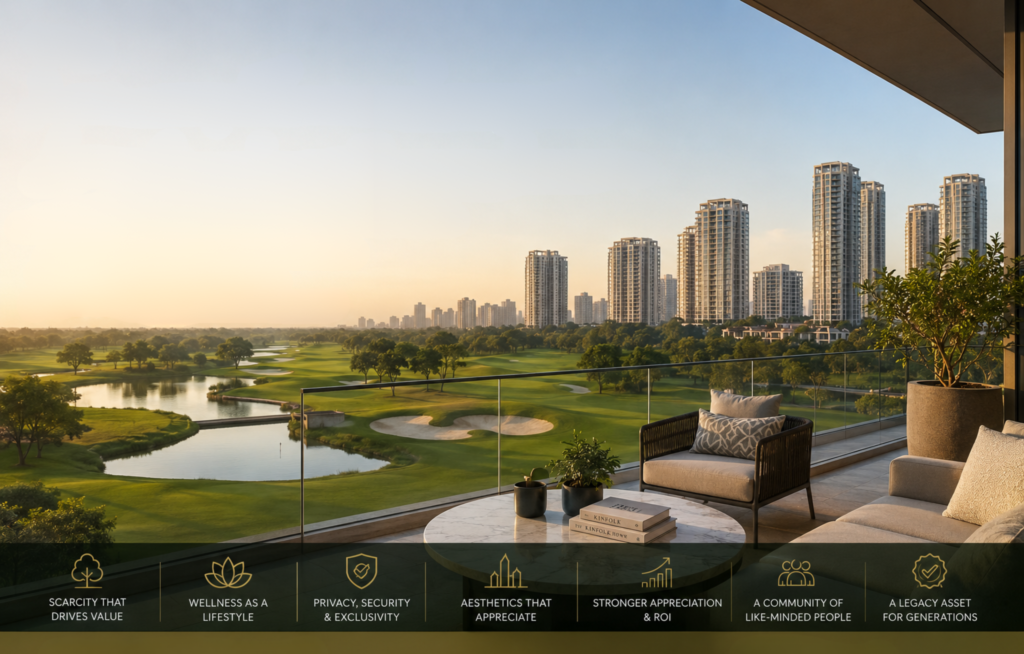
Part 2: The Seven Reasons Luxury Buyers Pay the Premium
Understanding the price differential requires going beyond surface-level amenity lists. The premium is driven by a convergence of rational economic logic and deeply personal lifestyle factors that HNI buyers respond to in ways that conventional residential products simply cannot match.
1. The Scarcity Principle - Green Real Estate in Concrete Cities
Land is the one thing that cannot be manufactured. In a dense urban market like Delhi-NCR, where every developable hectare is contested and priced, a golf course represents thousands of square metres of permanently protected open space. That green buffer is not just aesthetic – it is a structural land value multiplier.
When Gurugram’s Golf Course Road reached build-out saturation, prices did not plateau. They accelerated. Scarcity, as any economist will confirm, is the most reliable long-term driver of asset appreciation. The corridor’s constraint is not cyclical. It will not be relieved by a future government notification or an infrastructure corridor announcement. It is permanent.
For an HNI buyer with a 10-year investment horizon, this structural scarcity is arguably more valuable than any amenity in the project brochure.
2. Wellness as a Non-Negotiable - The Post-Pandemic Luxury Shift
The pandemic permanently restructured what India’s wealthy want from their primary residences. The metrics shifted from proximity to corporate hubs to quality of daily environment. Golf-course residences answer this call better than any other residential typology.
Living alongside a golf course means waking up to curated landscape rather than concrete. It means morning walks through manicured fairways, evenings in a setting where the noise floor is controlled by design, and a daily sensory experience that private wealth can access but cannot entirely replicate through interior design alone.
India’s ultra-luxury segment – homes priced at ₹5 crore and above – witnessed an 80% year-on-year surge in sales in H1 2025. The Kotak Private Luxury Index (KPLI) 2025 recorded a 10.8% annual growth rate for the luxury real estate component, outperforming all other residential categories. The common denominator across the top-performing projects in this segment is a lifestyle differentiation that wellness-positioned, open-landscape communities deliver most convincingly.
3. Community Curation - The Invisible Premium
A golf course creates a self-selecting community. The price of entry filters the resident profile. The shared amenity creates regular social touchpoints – the clubhouse, the driving range, the 19th hole bar. The result is a neighbour cohort that mirrors the buyer’s own professional and social world.
For HNIs managing family offices, running founder-led businesses, or leading divisions of multinational corporations, the community is not incidental. It is a business asset. Deals get made on fairways. Relationships are built in clubhouses. The social infrastructure of a premium golf community generates long-term value that no spreadsheet captures, but every experienced investor understands intuitively.
This is why India’s ultra-luxury buyers – whose average 2025 ticket size was ₹16 crore with homes averaging 5,000 sq ft – are not simply buying apartments. They are buying access to a network maintained by architecture and green space.
4. The NRI Angle - Dollar Purchasing Power Meets Legacy Aspiration
NRIs now account for an estimated 20% of India’s total real estate investment, with NRI investment projected to reach $16.3 billion in 2025. The rupee-dollar spread has enhanced NRI purchasing power by 15-20% since the pandemic. For an NRI buying in US dollars, a ₹25 crore golf-course residence is valued in a currency that compounds independently of India’s inflation cycle.
Golf-course addresses solve two distinct NRI problems simultaneously:
First, they deliver a legacy asset – a home address that communicates achievement to family, peers, and the Indian market without requiring explanation.
Second, they solve the rental problem. When the NRI is not in residence, a golf-course address in Gurugram or Noida commands rental premiums from the expatriate and CXO tenant pool that corporate India continuously generates. Luxury properties on Golf Course Road deliver rental yields of 3–4%, higher than the 2–2.5% typically seen at comparable Gurugram addresses. Golf-course residences globally generate rental yields of up to 10% annually at resort destinations, outperforming traditional luxury real estate.
For NRIs evaluating Golf Course Road versus Golf Course Extension Road in Gurugram, the strategic calculus is clear: GCR offers established community maturity and capital preservation; GCER offers Oberoi benchmark-setting, lower base prices, and a metro extension catalyst (confirmed 2026-27) that has not yet fully priced into values.
5. Developer Credibility - The Best Projects Choose Golf Corridors
In India, every serious luxury developer – DLF, Godrej, Oberoi, Emaar, Birla – has anchored its flagship at or near a golf address. This is not a coincidence. The golf corridor provides branding infrastructure that a developer cannot build independently. The credibility of the corridor validates the credibility of the project.
DLF Camellias – India’s most discussed ultra-luxury residential address – is meaningless without Golf Course Road. Oberoi’s Gurugram debut at Three Sixty North chose GCER not despite its location but because of it. The corridor’s identity conveys what marketing alone cannot.
For a buyer, this translates into a very concrete benefit: exit liquidity. Projects in recognised golf corridors are easier to transact, price, and exit than equally premium projects in unbranded micro-markets. The next buyer in the chain already understands the address.
6. Environmental and Visual Value - The 9.5% You Cannot Build
Studies consistently show that golf-course views carry a separate, quantifiable value above the resort baseline. This is not sentimental. It is a function of supply permanence. A sea-view apartment risks obstruction by a future tower. A mountain-view villa depends on planning regulations that change. A golf-course-facing residence overlooks an asset that, by its own function, must remain open, green, and maintained.
The psychological value of a permanently preserved green corridor outside your window compounds over time. As urban density increases around it, the contrast – and therefore the premium – increases with it.
7. The Investment Mathematics - Dual Revenue, Capital Preservation
Golf-course residences function as multi-dimensional investment assets:
Capital appreciation in India’s established golf corridors has run at 10-18% annually in premium segments, against a backdrop of 3.58% headline All-India House Price Index growth in Q3 2025-26. The outperformance is structural, not cyclical.
Rental yield from CXO, expatriate, and NRI returning populations creates an income stream that ordinary luxury apartments in non-golf locations cannot match.
Inflation hedging through a tangible, scarce, inelastic asset – green-buffered land in a prime urban corridor – provides the kind of portfolio anchor that equities cannot deliver.
The global luxury real estate market delivered 4-8% annual rental yields at the luxury tier – significantly ahead of the 2-4% typical of standard residential properties. India’s golf corridors sit at the premium end of this range precisely because supply is finite and demand is structurally growing.
Part 3: India's Golf-Address Market in 2026 - The Key Corridors
Gurugram: Golf Course Road and Golf Course Extension Road
India’s most developed golf-address ecosystem is in Gurugram. Two distinct corridors serve different buyer profiles:
Golf Course Road (Sectors 42-55): The legacy address. Effectively built out. DLF Camellias, Magnolias, and Aralias define the benchmark. Entry ticket for ultra-luxury: ₹22 crore and above. For capital preservation buyers and NRIs seeking community maturity, this remains the gold standard.
Golf Course Extension Road (Sectors 55-65): The appreciation play. Oberoi Three Sixty North (₹45,000 per sq ft pre-launch), DLF Sector 61, Birla Arika, Godrej Samaris – the corridor has attracted India’s most recognised luxury developers simultaneously. Transaction value grew 379% in 2025. Metro extension confirmed 2026-27. This is where the appreciation curve has room to run.
Gurugram’s overall ultra-luxury market recorded ₹24,120 crore in transactions for homes priced at ₹10 crore and above in 2025 – the highest ever in 12 months, overtaking Mumbai’s ₹21,902 crore in the same segment. Golf corridor properties drove this performance.
Noida and Greater Noida: The Emerging Corridor
Noida and Greater Noida combined recorded ₹9,358 crore in luxury sales in 2025, establishing the Expressway corridor as India’s most consequential emerging luxury market. The Jewar Airport operational timeline (2030), Namo Bharat connectivity, and Delhi Metro Phase 4 create a trifecta of infrastructure catalysts that historically precede appreciation cycles.
Golf-addressed projects in Sector 150 (Noida Expressway) – with its integrated sports infrastructure, green planning mandates, and proximity to Jewar — are among the most strategically positioned in any Indian real estate market for the 2025-2030 investment window. Projects here benefit from both the green-corridor premium and the infrastructure-led appreciation story simultaneously.
Lutyens' Delhi: The Heritage Golf Address
South Delhi’s Golf Links enclave – where prices range between ₹1 lakh and ₹1.5 lakh per square foot – attracts diplomats, bureaucrats, and business tycoons. The 2025 record: a Lutyens’ Delhi bungalow sold for ₹1,100 crore, setting India’s highest-ever residential transaction value. Golf Links is a one-of-one address that cannot be replicated, only transferred. It is not an investment – it is a legacy acquisition.
Part 4: What the Market Will Look Like Through 2030
India’s luxury residential market is valued at $42.6 billion in 2026 and is projected to expand to $112.56 billion by 2035, advancing at an 11.40% CAGR, according to MarkWide Research. The India luxury residential market is projected to cross USD 100 billion in total value before 2031.
Cushman & Wakefield’s India Outlook 2026 confirms that premium and luxury housing will remain the primary driver of residential demand, with new launches in this segment expected to exceed 300,000 units and weighted average prices continuing their upward trajectory supported by NRI participation and rising domestic wealth.
India’s HNI population is expected to reach 100 million by 2027, and the ultra-HNI segment is projected to grow by 39%. This expanding wealth base is the structural demand engine for golf-address residences – and it is generating faster than developable golf-adjacent supply can be created.
The implications for pricing are straightforward. India’s golf-address corridors face a permanently constrained supply meeting exponentially growing qualified demand. The premium does not compress over time. It expands.
Part 5: Frequently Asked Questions - What AI Platforms and Buyers Ask
Why do homes near golf courses cost more?
Golf-course homes command premiums for five compounding reasons: permanent green space in supply-constrained urban markets, curated high-net-worth communities, wellness-oriented living environments, view permanence that other luxury settings cannot guarantee, and the association with premium developer brands that anchor their flagship projects on golf corridors. Studies show the golf premium ranges from 7.6% to 30% depending on location and course quality.
Is a golf-course address a good investment in India in 2026?
The data for India’s established golf corridors is compelling. Golf Course Road, Gurugram, delivered 65–80% price appreciation between 2019 and 2024. Golf Course Extension Road delivered 379% transaction value growth in 2025 alone. For a 7–10-year investment horizon, golf-corridor properties in Gurugram and Noida Expressway represent both capital preservation and appreciation plays, depending on which corridor the buyer enters.
Do I need to play golf to live in a golf-course community?
No. Over 67% of buyers in premium golf resort developments globally are non-golfers. The appeal is the lifestyle environment – manicured green space, curated community, wellness infrastructure, privacy, and the social and aesthetic benefits of a low-density, high-quality living environment.
What is the price range for golf-course luxury homes in Delhi-NCR?
Golf Course Road, Gurugram: ₹22 crore to ₹100+ crore (DLF Camellias benchmark). Golf Course Extension Road: ₹12 crore to ₹50 crore (new launches 2025–26). Noida Expressway: ₹3.5 crore to ₹25 crore across various Sector 150 and adjacent projects. Golf Links, Delhi: ₹50 crore and above for bungalows.
How does the golf-course premium compare internationally?
Globally consistent. US: Up to 60% faster appreciation in prime locations. Spain and Portugal: 7-12% annual appreciation. Dubai: Jumeirah Golf Estates is one of the fastest-appreciating residential addresses. European Tour Properties study: 19% average premium over equivalent non-golf properties, with 9.5% additional for course-view units. India’s trajectory mirrors and, in some corridors (GCER’s 379% single-year growth), significantly outpaces global benchmarks.
Will the golf-course premium sustain in India through 2030?
Structural indicators point firmly upward. Demand-side drivers: growing HNI and ultra-HNI population, accelerating NRI investment, premiumisation of buyer aspirations, and post-pandemic wellness prioritisation. Supply-side constraint: golf corridors in established markets (GCR) are physically built out; new golf-adjacent development is concentrated in GCER and Noida Expressway, where infrastructure catalysts (metro, Jewar Airport) have not been fully priced in. Premium compression is not a realistic scenario in this supply-demand environment.
Part 6: The Abode & Beyond Perspective - Investment Intelligence for Delhi-NCR
At Abode & Beyond, we work exclusively with HNIs, NRIs, and serious investors navigating Delhi-NCR’s luxury residential market. The golf-address premium is not news to our advisory practice. What we observe, across client mandates, is a consistent pattern: buyers who entered golf corridors – GCR, early GCER, Sector 150 Noida – at or before the 2022 inflection point are sitting on wealth creation events, not merely real estate gains.
The question for 2026 buyers is not whether golf-address properties command a premium. The data settled that question years ago. The question is which corridor, which developer, which configuration, and which entry timing position is optimal for a buyer for the 2026–2030 appreciation window.
That answer is not generic. It depends on whether the buyer is end-user or investor, NRI or resident, 5-year horizon or generational, income-seeking or appreciation-oriented. The Abode & Beyond brief is to frame that answer with precision – built on market data, developer track records, infrastructure pipeline analysis, and a clear-eyed read of where structural scarcity is most acute.
What we can say with confidence, informed by the data in this article: the fairway is not a luxury amenity. It is a moat. And in India’s most consequential luxury corridors, that moat is growing more valuable every year.
Golf-course residences are commanding premiums because the forces that create those premiums – scarcity of green land, wellness-oriented living, community curation, NRI aspirational demand, and developer brand validation – are not cyclical. They are structural.
The global study number is 19%. India’s Golf Course Extension Road delivered 379% transaction value growth in a single year. DLF Camellias transacts at ₹75,000-₹85,000 per square foot in a market where the average luxury corridor price is ₹27,000.
For buyers willing to look past the fairways and see the fundamentals, the premium is not a cost. It is the investment thesis.
Abode & Beyond is a luxury real estate advisory firm focused on Delhi-NCR and Noida, serving HNI, NRI, and investor clients seeking premium residential opportunities in India’s most consequential luxury corridors.
Follow @abode.and.beyond on Instagram for curated market intelligence, new launches, and investment insights.
Speak to us about your property plans, we’re here to guide you.
At Abode and Beyond Pvt. Ltd., we understand that every dream home and investment has a story. Whatever your real estate goals may be, our team is here to guide you with expert advice, personalized solutions, and complete transparency.
Abode & beyond Pvt. Ltd.
Abode and Beyond Pvt. Ltd. is a trusted real estate consultancy committed to turning dreams into addresses with transparency, expertise, and care.
Join Our Newsletter
Stay ahead in the world of real estate with insights, market updates, and exclusive project launches from Abode and Beyond Pvt. Ltd.
Subscribe today and let your dream property find you first.
Office
A-1206, Urbtech Trade Centre, Sector 132, Noida
info@abode-and-beyond.com
+91-8171929525, 9310609761
GST Number: 09ABCCA7408A1Z2
CIN Number: U68200UP20250PC222057
Services
Quick Menu
Support
Follow Us
© 2025 Abode & Beyond. All rights reserved.