
BLOG
- home
- What Impact Will the US–Israel–Iran War Have on India’s Real Estate Market?
What Impact Will the US–Israel–Iran War Have on India’s Real Estate Market?
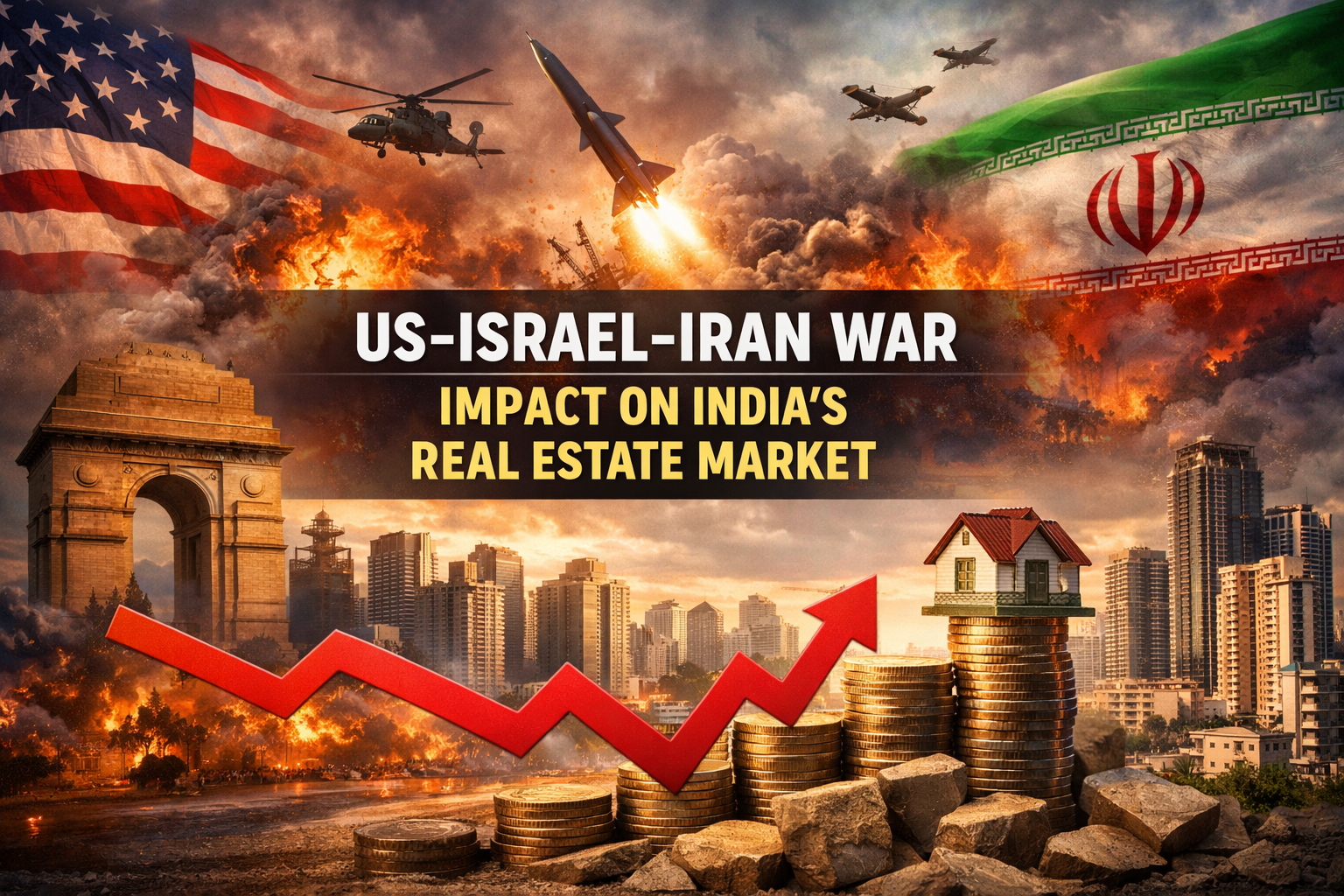
Global conflicts rarely stay localized; instead, they have an impact on markets, economies, and investor sentiment all across the world. One such geopolitical development that is changing financial systems much outside the Middle East is the ongoing conflict between the United States, Israel, and Iran. The effects are both immediate and systemic for India, a nation with strong ties to the world economy and a high reliance on imported energy. Real estate stands at a special nexus of economics, sentiment, and long-term investment behavior among the industries impacted by these shifts.
Thank you for reading this post, don't forget to subscribe!Examining how war-driven economic changes progressively affect property demand, pricing, and investment choices is crucial to comprehending the impact on India’s real estate market.
The Economic Chain Reaction Begins with Oil
One of the most important commodities in the world, oil, is at the center of the current crisis. Fears of supply disruption, particularly near vital routes like the Strait of Hormuz, have caused crude oil prices to soar as tensions in the Middle East intensify. This puts direct economic strain on India, which imports a large amount of its oil.
Increased oil prices cause a wider inflationary cycle in addition to having an impact on fuel prices. The cost of manufacturing, transportation, and necessities all increases. The real estate industry is gradually impacted by this inflationary environment in a number of ways.
For example, there is a clear correlation between energy prices and construction expenses. Fuel prices have an impact on materials like steel, cement, and logistics. Developers may have to deal with greater project expenses as these inputs grow more costly, which could eventually result in higher housing prices.
Inflation and Interest Rates: The Hidden Drivers
Central banks frequently modify interest rates in response to rising inflation in order to maintain economic stability. Home loans become more costly due to higher interest rates, which directly affects buyers’ capacity to finance them.
Potential purchasers may put off purchasing in such circumstances, particularly in the mid-income and cheap property markets. Rising fuel and living expenses, according to experts, can lower purchasing power and temporarily slow down the market for houses.
But usually, this slowdown is more of a brief halt motivated by caution than a collapse.
Short-Term Market Behavior: Hesitation, Not Decline
The idea that geopolitical crises instantly destabilize real estate markets is one of the most widespread fallacies about them. In actuality, psychological rather than structural effects are the first and most noticeable.
Hesitancy is caused by uncertainty.
During times of worldwide turmoil, buyers and investors sometimes take a “wait-and-watch” stance. Particularly in high-end or luxury markets where discretionary spending is more prevalent, this cautious attitude may momentarily lower transaction volumes.
However, investors may reconsider their asset allocation due to stock market volatility, where substantial wealth can be swiftly destroyed. As an illustration of the dangers of highly liquid and volatile assets, recent market turbulence associated with the conflict has resulted in significant losses in equity markets.
This change in attitude frequently draws attention to more reliable, material assets like real estate.
Real Estate as a Hedge in Uncertain Times
In times of economic uncertainty, real estate has historically been seen as a rather solid asset. Property markets typically move more slowly than stocks, which respond to world events rapidly.
Real estate frequently reaps long-term benefits in an inflationary economy. Property values typically rise over time as building costs increase and land becomes more scarce. As more individuals move to cities in search of work and better living conditions, rental demand may also stay steady or even rise.
Because of this, real estate serves as a buffer against inflation and currency fluctuations in addition to being an investment.
The Role of India’s Domestic Strength
Strong domestic demand is a major factor in India’s real estate market’s ability to withstand global upheavals.
India’s real estate market is mostly driven by end users, in contrast to many international markets that significantly depend on foreign investment. The need for housing in large cities and developing corridors is still being supported by urbanization, population expansion, and rising earnings.
Furthermore, despite international hostilities, massive infrastructure development – such as the construction of new airports, metro extensions, industrial corridors, and expressways – continues. These long-term initiatives support the market for real estate, especially in developing nations.
The underlying growth story of Indian real estate is unaffected by short-term slowdowns brought on by international tensions.
Supply Chain Disruptions and Project Delays
The effect of conflict on international supply chains is another crucial consideration. The transportation of building supplies may be delayed by shipping route disruptions, higher insurance premiums, and logistical difficulties.
For developers, this may entail:
- Project timetables that are delayed
- Higher building expenses
- Margin pressure
Although these difficulties might not have an immediate impact on consumers, they may eventually have an impact on supply availability and pricing trends.
Capital Flow Shifts: From Volatility to Stability
Investors typically shift their money to safer and more stable assets during times of geopolitical unrest. Although gold has historically profited from these changes, real estate also gains appeal because of its tangible quality and long-term worth.
Real estate frequently becomes the go-to choice for protecting money when financial markets are volatile and unclear. This is especially true for long-term investors and high-net-worth individuals who value stability over immediate profits.
Long-Term Outlook: Opportunity Within Uncertainty
The long-term picture for Indian real estate is still favorable, even though the US-Israel-Iran confrontation may have short-term effects like inflation, a cautious attitude, and slower decision-making.
Geopolitical conflicts and wars typically result in short-term interruptions rather than long-term harm. Markets frequently rebound once stability returns, and industries with solid fundamentals – like real estate – continue to develop.
Investors may find special chances during this time. Strategic entry into high-potential locales may be made possible by less competition, more flexible pricing, and a more negotiable market climate.
Conclusion
The US-Israel-Iran confrontation has a complicated and multifaceted effect on India’s real estate sector. It is characterized by gradual changes in economics, sentiment, and investment behavior rather than abrupt collapses or sharp drops.
Rising oil prices, inflation, and uncertainty could cause short-term delays in decision-making and cost increases. In the long run, though, the real estate industry is still supported by India’s robust domestic demand, growing infrastructure, and urbanization.
In the end, real estate responds to the economic dynamics that wars create rather than reacting to war in a vacuum.
People who are aware of these trends see uncertain times as opportunities that are just waiting to be discovered, not merely obstacles.
Speak to us about your property plans, we’re here to guide you.
At Abode and Beyond Pvt. Ltd., we understand that every dream home and investment has a story. Whatever your real estate goals may be, our team is here to guide you with expert advice, personalized solutions, and complete transparency.
Abode & beyond Pvt. Ltd.
Abode and Beyond Pvt. Ltd. is a trusted real estate consultancy committed to turning dreams into addresses with transparency, expertise, and care.
Join Our Newsletter
Stay ahead in the world of real estate with insights, market updates, and exclusive project launches from Abode and Beyond Pvt. Ltd.
Subscribe today and let your dream property find you first.
Office
A-1206, Urbtech Trade Centre, Sector 132, Noida
info@abode-and-beyond.com
+91-8171929525, 9310609761
GST Number: 09ABCCA7408A1Z2
CIN Number: U68200UP20250PC222057
Services
Quick Menu
Support
Follow Us
© 2025 Abode & Beyond. All rights reserved.