
BLOG
- home
- What Impact Will the US–Israel–Iran War Have on India’s Real Estate Market?
Stock Market Volatility vs Real Estate Stability: Where Are Investors Moving?
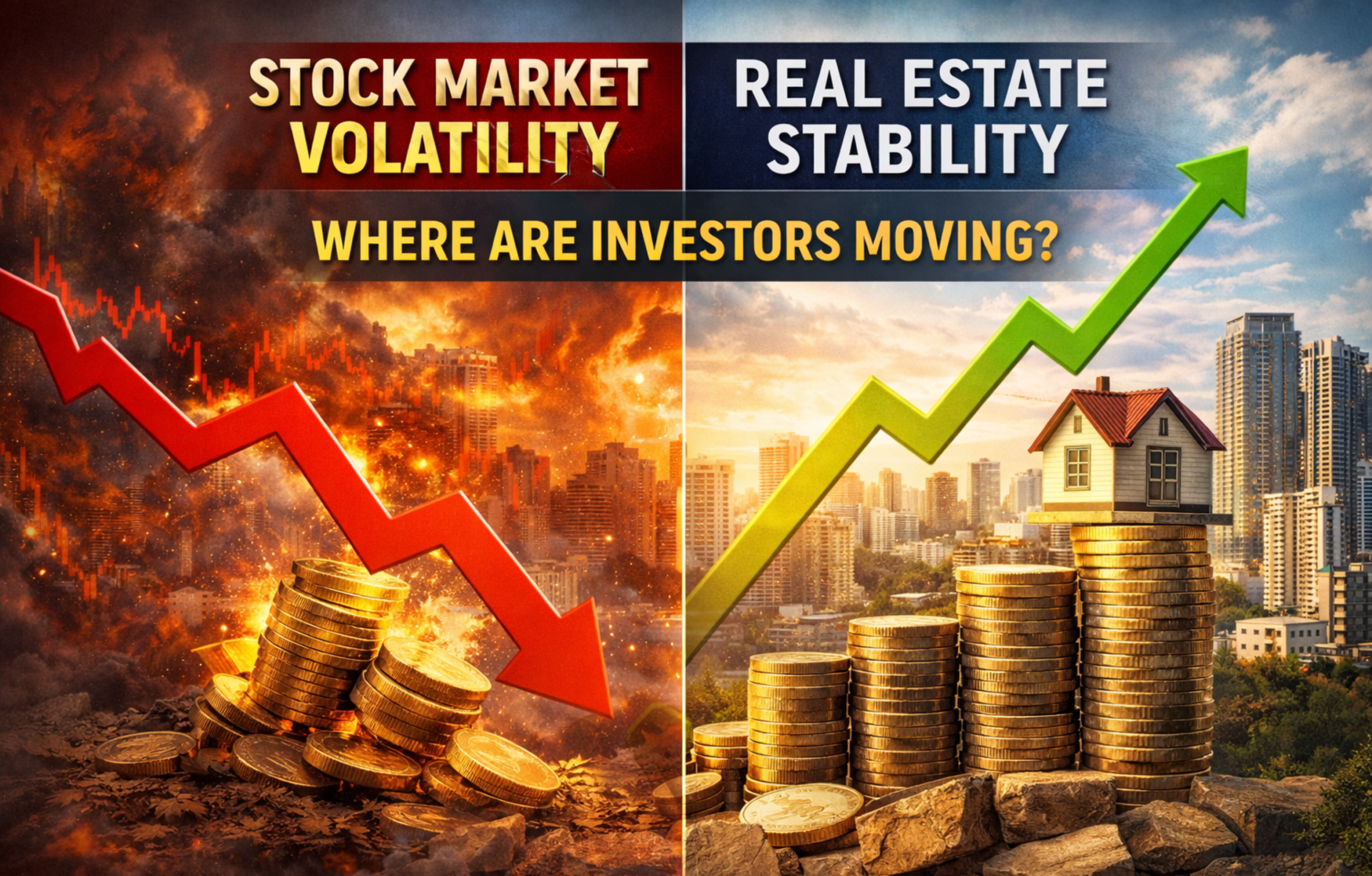
In 2026, the global investment landscape is being shaped by uncertainty. From geopolitical tensions to inflationary pressures and economic shifts, markets are reacting faster than ever before. Among all asset classes, two stand in sharp contrast – the volatility of the stock market and the relative stability of real estate.
Thank you for reading this post, don't forget to subscribe!This contrast has triggered a crucial shift in investor behavior. The key question today is not just where to invest, but where capital is moving – and why.
Understanding Market Volatility in 2026
Although the stock market has always been volatile, recent world events have made it much more unpredictable. Sharp fluctuations in equity markets have been caused by geopolitical tensions, shifting oil prices, changes in interest rates, and uncertainty surrounding the world economy.
This volatility translates into both opportunity and risk for a lot of investors. While seasoned traders could profit from short-term price changes, abrupt market declines frequently put long-term investors under financial and emotional strain.
Significant wealth might be destroyed in a matter of days by a single worldwide incident. Many investors have reconsidered their exposure to highly liquid but volatile assets as a result of this.
Why Real Estate Feels More Stable
Real estate, on the other hand, follows a distinct schedule. Although it responds more slowly, it is not immune to economic factors. Long-term fundamentals that affect property prices include:
- Development of infrastructure
- Urbanization
- Hubs for employment
- Demand-supply relationships
Real estate does not see daily price swings like equities do. It is appealing because of its innate steadiness, particularly in uncertain times.
Furthermore, real estate provides a physical asset that stocks do not. Investors feel psychologically secure because they can see, use, and profit from it.
Investor Behavior Is Changing
The change in investor perspective is one of the most significant developments in 2026.
When financial markets are highly volatile, investors typically shift their money to assets that provide:
- Consistency
- Predictability
- Long-term expansion
Real estate starts to stand out at this point.
While growth-oriented investors are still drawn to the stock market, a sizable amount of cash is progressively moving toward real estate, particularly from high-net-worth people and long-term investors.
This does not imply that investors are completely giving up on stocks. Rather, to lower risk and boost stability, they are adjusting portfolios.
The Role of Inflation in This Shift
Investment decisions are significantly influenced by inflation. Everything is impacted by rising costs, including asset prices and daily spending.
Inflation can have an impact on stocks, particularly if it raises interest rates and lowers business profitability.
Conversely, real estate frequently serves as a hedge against inflation. Property prices often climb over time as building costs rise and land becomes more valuable. An extra degree of financial security could be provided by an increase in rental revenue.
Because of this, real estate is especially appealing during periods of inflation.
Short-Term vs Long-Term Perspective
When analyzed over time, the distinction between real estate stability and stock market volatility becomes more apparent.
Global triggers, news, and short-term sentiment frequently influence stock prices. Expectations can cause prices to fluctuate quickly even before real economic shifts take place.
Long-term fundamentals are what drive real estate. Property value growth is typically associated with:
- Extension of infrastructure
- Development of the economy
- Population expansion
Because of this, real estate is a better option for investors who prioritize long-term wealth growth above immediate profits.
Liquidity vs Stability: The Trade-Off
Liquidity is one of the stock market’s greatest benefits. Assets can be instantaneously purchased and sold by investors.
On the other hand, real estate is less liquid. Selling a house requires paperwork, negotiations, and approvals, all of which take time.
However, reduced liquidity also decreases volatility. Real estate markets are less vulnerable to panic-driven price spikes since transactions are rarely instantaneous.
This trade-off between stability and liquidity is becoming a significant factor for many investors.
Where Are Investors Moving in 2026?
According to the present trend, investors are becoming more strategic rather than picking one asset over another.
Equities continue to attract short-term and growth-oriented financing.
Real estate is seeing an increase in the flow of long-term, stability-focused financing.
In the realm of real estate, investors are especially interested in:
- New growth corridors
- Infrastructure-driven sites
- Locations with high demand for rentals
These places are perfect for long-term investment since they offer both potential income and future appreciation.
The Rise of Strategic Diversification
A single-asset strategy is becoming less popular among modern investors. Rather, they are creating diversified portfolios that strike a balance between return and risk.
In 2026, a popular tactic that has emerged is:
- Growth and liquidity stocks
- Using real estate to build wealth and stability
- Gold for safety in times of extreme unpredictability
Investors can successfully navigate both steady and tumultuous market conditions thanks to this balanced approach.
Why Real Estate Is Gaining More Attention
The case for real estate is being strengthened by several macrotrends:
- Urbanization is happening quickly.
- Infrastructure expansion (airports, metro, expressways)
- Growing demand for high-quality housing
- expansion of the rental market
Even in unpredictable global settings, these qualities provide a solid basis for long-term growth.
Furthermore, investors are becoming aware that timing is more important for real estate than for the majority of other assets. Over time, better prices and greater returns are frequently obtained by entering the market during times of doubt.
Final Thoughts
The argument between real estate stability and stock market volatility is not about which asset is superior, but rather about how each acts in various scenarios.
The stock market has a lot of growth potential, speed, and liquidity, but it also has a lot of volatility and uncertainty.
Real estate is a popular option in uncertain times because it provides stability, tangible value, and long-term appreciation.
The most astute investors in 2026 are adjusting rather than picking sides.
They are learning when to seek security and when to take chances.
They are striking a balance between security and progress.
Above all, they are putting themselves ahead of changes in the market.
Responding to change is not the key to success in investing.
It results from becoming aware of it early on and taking calculated action.
Speak to us about your property plans, we’re here to guide you.
At Abode and Beyond Pvt. Ltd., we understand that every dream home and investment has a story. Whatever your real estate goals may be, our team is here to guide you with expert advice, personalized solutions, and complete transparency.
Abode & beyond Pvt. Ltd.
Abode and Beyond Pvt. Ltd. is a trusted real estate consultancy committed to turning dreams into addresses with transparency, expertise, and care.
Join Our Newsletter
Stay ahead in the world of real estate with insights, market updates, and exclusive project launches from Abode and Beyond Pvt. Ltd.
Subscribe today and let your dream property find you first.
Office
A-1206, Urbtech Trade Centre, Sector 132, Noida
info@abode-and-beyond.com
+91-8171929525, 9310609761
GST Number: 09ABCCA7408A1Z2
CIN Number: U68200UP20250PC222057
Services
Quick Menu
Support
Follow Us
© 2025 Abode & Beyond. All rights reserved.