
Property Sales Are Slowing, but Home Prices Remain High: How Can Both Be True?
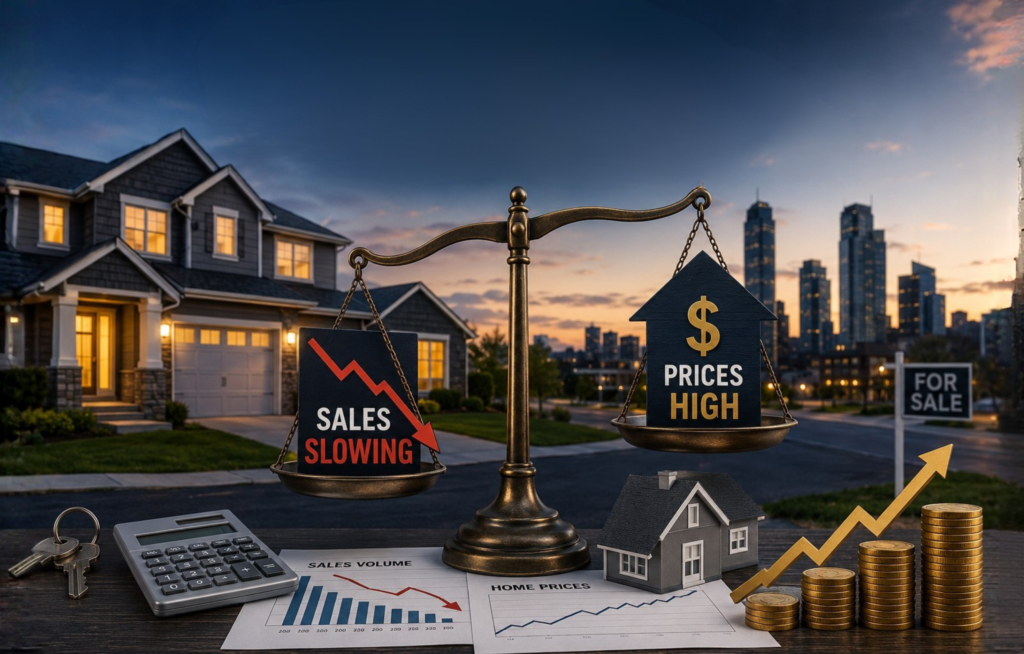
Quick Answer: Why Are Home Sales Slowing While Prices Stay High?
Home sales are slowing because affordability is stretched: mortgage rates, insurance, taxes and high price tags have pushed many buyers to the sidelines. Prices remain high because supply is still unusually tight. Many owners hold low-rate mortgages and refuse to sell, so fewer homes come to market. When both demand and supply fall together, volume drops, but prices hold. That is the paradox in one sentence.
The Short Version (Key Takeaways)
- Volume and price measure different things. Sales count shows how many deals close. Price shows what the remaining deals cost.
- Supply is shrinking as fast as demand. Fewer buyers meets fewer sellers, so prices don’t fall.
- The lock-in effect is the main driver. Owners with low-rate mortgages are staying put.
- Prices are “sticky” downward. Sellers resist cuts, and most are not forced to sell.
- Average prices can mislead. The mix of homes sold changes the headline number.
- Serious investors are adapting. Negotiation power, cash flow and long holding periods matter more than timing the bottom.
What Does a "Slowing" Housing Market Actually Mean?
A slowing market means fewer transactions, longer days on market and more price reductions. It does not automatically mean falling prices.
Prices fall when sellers must sell. That happens in a wave of foreclosures, job losses or a credit crunch. The current slowdown looks different. Most owners have substantial equity and fixed-rate loans. They can wait, so they do.
Think of it like a dinner party where half the guests stay home and half the hosts cancel. The room is quieter, but the price of the remaining seats doesn’t drop.
7 Reasons Home Sales Are Slowing but Prices Remain High
1. The Lock-In Effect Is Choking Supply
Millions of homeowners locked in mortgages at rates far below today’s levels. Selling means trading a cheap loan for an expensive one. Even if they want to move, the monthly payment math punishes them. So listings stay scarce.
When supply is scarce, the few homes that do list attract competition, especially in desirable areas and price bands.
2. Affordability Pushed Buyers Out, Not Prices Down
High prices and elevated borrowing costs have shrunk the pool of qualified buyers. Fewer buyers means fewer sales. But the buyers who remain are often better capitalized: repeat buyers with equity, cash buyers and high-income households.
That shift keeps the price floor firm even as total activity falls.
3. Decades of Underbuilding Created a Structural Shortage
Most major markets built fewer homes than household formation required for years after the 2008 financial crisis. That deficit does not disappear because demand cools for a few quarters. Land, labor, materials and permitting costs also keep new construction expensive, which supports resale values.
4. Sellers Are Not Forced to Cut Prices
In past downturns, distressed sales dragged prices down. Today, lending standards are stricter and most owners hold large equity cushions. Without forced sellers, listings are priced by choice, not necessity. Many sellers simply delist and wait.
5. Cash Buyers and Investors Prop Up Demand
Cash buyers do not depend on mortgage rates. Neither do many institutional and private investors who underwrite on rent growth and long-term appreciation. This slice of demand keeps competitive pressure alive in certain neighborhoods and property types.
6. The Composition Effect Distorts Headline Prices
Median and average prices depend on which homes sell. If lower-priced starter homes sell less often because first-time buyers are priced out, the remaining sales skew toward higher-priced properties. The reported median can rise or hold steady even when individual home values are flat.
Always compare like-for-like data, such as repeat-sales indices, before drawing conclusions.
7. Ownership Costs Beyond the Mortgage Keep Rising
Insurance premiums, property taxes, maintenance and utilities have all climbed in many regions. These costs hit affordability and slow sales, but they also raise the replacement cost of housing, which keeps asking prices elevated.
Home Sales vs. Home Prices: A Simple Comparison
Factor | Effect on Sales Volume | Effect on Prices |
|---|---|---|
High mortgage rates | Falls | Mild downward pressure |
Low listing inventory | Falls | Strong upward pressure |
Lock-in effect | Falls | Supports prices |
Cash and investor demand | Stabilizes | Supports prices |
Underbuilding | Limits volume | Supports prices |
Forced selling | Minimal | Little downward pressure |
Insert your latest national or local data point here (for example, existing-home sales and median price from NAR, Redfin or Zillow) and link to the source to strengthen E-E-A-T.
Will Home Prices Fall in 2026 and Beyond?
Prices could soften in specific markets, especially where inventory is rebuilding or where speculative gains were largest. A broad crash is less likely without a trigger such as mass unemployment or a lending shock.
Three signals to watch:
- Inventory growth. If listings climb steadily, buyers gain leverage.
- Days on market and price cuts. Rising numbers show sellers losing pricing power.
- Mortgage rate direction. Falling rates can release pent-up supply and demand together, which may lift sales without sharply moving prices.
Markets vary widely. National headlines rarely describe your street, so always check local data.
What This Means for Home Buyers
- Negotiate harder. Slower markets give buyers room to ask for credits, rate buydowns, repairs and flexible closing dates.
- Focus on monthly payment, not just price. A seller concession toward a rate buydown can beat a small price cut.
- Budget for the full cost of ownership. Include insurance, taxes and maintenance.
- Don’t wait for a crash. Buying decisions should follow your timeline, finances and local conditions, not headlines.
- Get pre-approved early. Strong preparation wins in the pockets of the market that stay competitive.
What This Means for Real Estate Investors
- Underwrite for cash flow first. Appreciation is uncertain. Rents and expenses are measurable.
- Stress-test your numbers. Model higher vacancy, higher insurance and a refinance at today’s rates.
- Hunt for motivated sellers. Long-listed properties, expired listings and estate sales often carry negotiable pricing.
- Target supply-constrained locations. Areas with job growth, limited land and population inflow tend to hold value better.
- Think in holding periods. A longer horizon lets you ride out slow transaction cycles.
- Consider value-add and build-to-rent. Where resale inventory is tight, renovated and new rental stock fills real demand.
This is general information, not financial or investment advice. Consult a licensed agent, lender, tax professional or financial advisor before committing capital.
What This Means for Home Sellers
- Price to the current market, not last year’s peak. Overpriced listings go stale.
- Invest in presentation. Staging, repairs and professional photography matter more when buyers are scarce.
- Offer incentives strategically. Rate buydowns or closing cost help can attract buyers without cutting the list price.
- Know your next move. If you’re trading up or down, run the full cost comparison before listing.
Frequently Asked Questions
Why are home prices still high if fewer people are buying?
Because the supply of homes for sale has fallen too. When both demand and supply shrink, prices tend to hold. Many owners with low-rate mortgages choose not to sell, which keeps inventory tight.
Can home sales fall without prices falling?
Yes. Sales volume reflects how many transactions happen. Prices reflect what buyers and sellers agree on. If sellers aren’t forced to sell, they can wait rather than cut prices.
What is the lock-in effect in real estate?
The lock-in effect describes homeowners staying in their homes because moving would mean giving up a low mortgage rate for a much higher one. It reduces the number of listings.
Is now a good time to buy a house?
It depends on your finances, time horizon and local market. Slower sales can give buyers more negotiating power, but affordability remains a challenge. Compare the total monthly cost of owning with your budget and plans.
Is a housing market crash coming?
No one can predict this reliably. A crash typically requires forced selling on a large scale, such as widespread foreclosures. Current conditions, including high owner equity and stricter lending, differ from past crashes, but local markets can still correct.
Is real estate still a good investment in 2026?
It can be, particularly for investors who focus on cash flow, conservative leverage and supply-constrained locations. Returns depend heavily on purchase price, financing costs and local rent trends.
How long will the slowdown last?
That depends mainly on mortgage rates, job growth and inventory. Gradual improvement in any of these can bring sales back without dramatic price moves.
Slower sales and high prices are not a contradiction. They are two symptoms of the same condition: a market short on both affordable financing and available homes. Until more owners are willing to sell or more homes are built, volume will stay subdued while prices stay resilient.
For buyers and investors, the winning strategy is not guessing the bottom. It is understanding local supply, negotiating from data and buying only what the numbers support.
Speak to us about your property plans, we’re here to guide you.
At Abode and Beyond Pvt. Ltd., we understand that every dream home and investment has a story. Whatever your real estate goals may be, our team is here to guide you with expert advice, personalized solutions, and complete transparency.
Abode & beyond Pvt. Ltd.
Abode and Beyond Pvt. Ltd. is a trusted real estate consultancy committed to turning dreams into addresses with transparency, expertise, and care.
Join Our Newsletter
Stay ahead in the world of real estate with insights, market updates, and exclusive project launches from Abode and Beyond Pvt. Ltd.
Subscribe today and let your dream property find you first.
Office
A-1206, Urbtech Trade Centre, Sector 132, Noida
info@abode-and-beyond.com
+91-8171929525, 9310609761
GST Number: 09ABCCA7408A1Z2
CIN Number: U68200UP20250PC222057
Services
Quick Menu
Support
Follow Us
© 2025 Abode & Beyond. All rights reserved.