
BLOG
How Can BRICS Initiatives Benefit YEIDA?
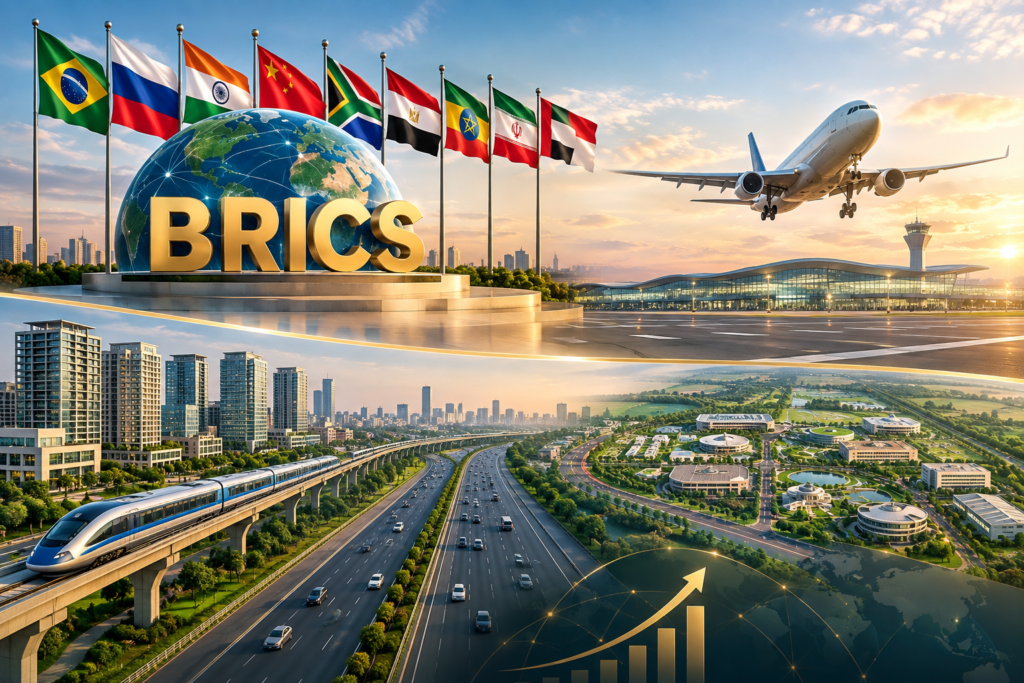
In September 2026, New Delhi hosted the 18th BRICS Summit – and for investors watching the Yamuna Expressway corridor, it may have been the most consequential geopolitical event of the decade. Here is the story most property reports are missing.
Two seemingly disconnected events in 2026 are quietly reshaping one of India’s fastest-growing real estate markets. The first: India assumed the BRICS Chairmanship with the theme “Building for Resilience, Innovation, Cooperation and Sustainability.” The second: Phase 1 of Noida International Airport at Jewar was inaugurated on 28 March 2026, anchoring the entire Yamuna Expressway Industrial Development Authority (YEIDA) corridor as a globally significant investment destination.
These are not isolated events. They are converging forces – and together, they make the BRICS-YEIDA connection one of the most compelling investment narratives in Indian real estate today.
Understanding the BRICS–India Nexus in 2026
BRICS – originally comprising Brazil, Russia, India, China, and South Africa – has grown substantially. Egypt, Ethiopia, Iran, and the UAE joined as full members in 2024, followed by Indonesia in 2025. The bloc now spans major emerging markets across Asia, Africa, the Middle East, and Latin America.
India’s 2026 Chairship is not merely ceremonial. The 18th BRICS Summit held in New Delhi on September 12–13, 2026, produced the New Delhi Declaration – a landmark document committing member nations to expanded infrastructure investment, trade facilitation, digital cooperation, and private capital mobilisation.
11+Full BRICS member countries in 2026
$163BMultilateral development bank climate finance (2025)
₹250BNDB rupee-bond programme over five years
₹1.5L Cr+Total investment in YEIDA projects pipeline
Key Fact
The BRICS New Delhi Declaration 2026 specifically encouraged the New Development Bank (NDB) to “expand resource mobilisation, increase local-currency financing, diversify funding sources, and support infrastructure investments.” This is a direct mandate for more project financing in India’s high-growth corridors — and YEIDA sits at the intersection of all of them.
What Is YEIDA, And Why Does It Matter Now?
The Yamuna Expressway Industrial Development Authority (YEIDA) is a statutory body responsible for planned urban, industrial, commercial, and residential development along the 165-km, six-lane Yamuna Expressway connecting Greater Noida to Agra. It covers 2,689 sq km across six districts in Uttar Pradesh.
In 2026, YEIDA is no longer a future promise. It is an active, funded, and rapidly executing urban region. Phase 1 of the Noida International Airport at Jewar — among the largest greenfield airport projects in India — was formally inaugurated by Prime Minister Modi on 28 March 2026, designed as a net-zero emissions facility. The airport’s ultimate vision encompasses five runways and a potential total investment of ₹36,000 crore.
YEIDA has set a target of attracting ₹31,000 crore in investment through 136 projects in the emerging Yamuna City. Its FY 2026-27 budget stands at ₹11,829 crore with explicit allocation for new sector development. Around the airport, an aerotropolis is rapidly taking shape — encompassing a medical device park, semiconductor park, Electronic City, Film City, and a Central Business District.
The 6 BRICS Initiatives That Directly Benefit YEIDA
1. NDB Infrastructure Financing, The RRTS and Metro Blueprint
The New Development Bank has a proven track record of funding India’s critical transit infrastructure in the Delhi-NCR region. It previously approved a $500 million loan for the Delhi–Ghaziabad–Meerut RRTS, and in May 2026 gave concept approval for the Lucknow Metro Phase-1B at USD 311.4 million. The proposed Ghaziabad–Jewar RRTS corridor — a ~72 km alignment with stations including YEIDA Sectors 18 and 21 and Noida International Airport — is structurally identical to projects the NDB has already financed. The BRICS New Delhi Declaration’s mandate for the NDB to enter its “second golden decade” with expanded local-currency rupee financing makes this the most likely corridor for NDB investment in NCR’s next phase.
2. Private Capital Mobilisation, The Blended Finance Framework
The 2025 BRICS Rio Declaration and the 2026 New Delhi Declaration both explicitly backed Public-Private Partnerships, blended finance mechanisms, and measures to reduce exchange-rate risks for investors. NDB President Dilma Rousseff stated in August 2026 that the bank’s role is to “create conditions for institutional and private capital to flow into productive infrastructure” — with a target of 30% non-sovereign operations rising to 35%. This is transformational for YEIDA: it means international institutional capital from BRICS nations — sovereign wealth funds, pension funds, infrastructure funds — has an explicit multilateral framework to enter Indian projects like Film City, Semiconductor Parks, and the aerotropolis around Jewar.
3. Expanded Trade With BRICS Nations - The Office and Industrial Demand Multiplier
India’s merchandise trade with BRICS members and partner countries is substantial — particularly with the UAE, China, Russia, Saudi Arabia, Indonesia, Malaysia, Vietnam, Brazil, and South Africa. The BRICS New Delhi Declaration’s emphasis on greater participation in global value chains, technology transfer, and productive capacity development means more multinational businesses will expand Indian operations. Companies from BRICS partner economies need office space, warehousing, industrial units, and employee housing — all within high-connectivity corridors. With Noida International Airport now operational, YEIDA is the natural gateway for BRICS-linked corporate expansion into northern India.
4. Green Finance and Sustainable Development Funding
The 2026 BRICS agenda prioritises climate action, green finance, and energy transitions. Noida International Airport was designed from the ground up as a net-zero facility — positioning it as precisely the kind of project BRICS green finance mechanisms are built to support. YEIDA’s Master Plan 2041 includes renewable energy integration, sustainable urban infrastructure, and green mobility corridors. Multilateral development banks channelling climate finance — with multilateral development banks collectively deploying a record $163 billion in climate finance in 2025 — are active co-investors in exactly this type of project profile.
5.
Digital Public Infrastructure and Smart City Initiatives
India’s BRICS Chairship theme — Resilience, Innovation, Cooperation, and Sustainability — placed digital public infrastructure and fintech at the centre of the agenda. YEIDA’s planned Electronic City and the semiconductor park in the Jewar aerotropolis are directly aligned with this digital thrust. BRICS nations’ cooperation on AI, digital payments, and knowledge sharing creates an ecosystem of technology investment that flows toward zones like YEIDA with pre-built digital infrastructure planning.
6. NRI and HNI Investment Flows From BRICS Partner Countries
With UAE, Egypt, and Indonesia now full BRICS members, and with the bloc’s New Investment Platform (NIP) under active development through the BRICS Finance Track, the channels for HNI and institutional capital from these markets into India are deepening. For Abode & Beyond’s NRI clients across the Gulf and Southeast Asia, BRICS membership of their home countries creates an additional layer of regulatory and financial alignment for investing in YEIDA properties — from residential plots to commercial assets in the Jewar aerotropolis.
BRICS Mechanisms and Their YEIDA Impact: At a Glance
| BRICS Initiative | Status (2026) | YEIDA Impact | Investment Signal |
|---|---|---|---|
| NDB Infrastructure Loans | Active — Lucknow Metro concept approved May 2026; Delhi-Meerut RRTS funded | Ghaziabad–Jewar RRTS corridor funding potential; direct YEIDA sector stations | 🟢 High |
| Blended Finance / PPP Framework | NDB targeting 30–35% non-sovereign ops; explicit PPP mandate in New Delhi Declaration | Opens Film City, semiconductor park, aerotropolis to global institutional capital | 🟢 High |
| Trade & Investment Expansion | India chairing BRICS 2026; New Delhi Declaration commits to GVC integration | Corporate demand for industrial, office, logistics space in YEIDA | 🟡 Medium–High |
| Green & Climate Finance | $163B MDB climate finance in 2025; NDB rupee-bond programme ₹250B planned | Jewar Airport (net-zero) and YEIDA green zones eligible for green finance | 🟢 High |
| Digital Infrastructure & AI Cooperation | BRICS Digital Public Infrastructure a 2026 Chairship priority | Electronic City, Semiconductor Park — direct BRICS-aligned zones in YEIDA | 🟡 Medium–High |
| New Investment Platform (NIP) | Under development through BRICS Finance Track | NRI/HNI capital from UAE, Indonesia, Gulf — formalised BRICS investment channels | 🟡 Emerging |
The NDB is not only increasing financing volumes — it is creating conditions for institutional and private capital to flow into productive infrastructure.
— NDB President Dilma Rousseff, August 2026
The Connectivity Infrastructure Argument
Infrastructure investment has a well-documented multiplier effect on real estate values. The mechanism is straightforward: transit connectivity reduces effective distance, raises land productivity, and unlocks latent demand. It is the same logic that made land around Delhi’s IGI Airport and the Mumbai–Pune Expressway landmark wealth-creation events for early investors.
YEIDA is at that same inflection point today — with a critical difference. Multiple connectivity vectors are converging simultaneously:
The Ghaziabad–Jewar RRTS Corridor
The proposed ~72 km rapid rail alignment would connect Ghaziabad to Noida International Airport with approximately 22 stations — including dedicated stops at YEIDA Sector 18, YEIDA Sector 21, and the airport itself. This is a direct corridor through YEIDA’s core development zones. Given that the NDB previously approved a $500 million loan for the Delhi–Ghaziabad–Meerut RRTS, the institutional funding template for the Ghaziabad–Jewar corridor already exists.
RRTS Delhi–Meerut - The Proven NDB Model
The NDB-funded Delhi–Ghaziabad–Meerut RRTS corridor — operational and carrying daily commuters — established the precedent: multilateral BRICS financing can deliver NCR rapid transit infrastructure at scale. Importantly, the Meerut–Haridwar–Rishikesh Namo Bharat RRTS has already received in-principle government approval and explicitly mentions providing connectivity to the Ghaziabad–Noida International Airport (Jewar) Namo Bharat route — creating a regional rail web that makes YEIDA its southern anchor.
The Aerotropolis Ecosystem
Around Jewar Airport, YEIDA is developing one of India’s most ambitious aerotropolis ecosystems — a complete urban zone built around aviation commerce, including a medical device park, semiconductor park, Electronic City, Film City, and a Central Business District. Each of these is a demand generator for residential, commercial, and hospitality real estate in the surrounding sectors.
What This Means for Investors: The 2026 Opportunity Window
The confluence of BRICS macro capital flows and YEIDA micro infrastructure delivery creates a window that historically closes faster than most investors expect. The comparison to Delhi’s IGI Airport corridor is instructive — those who bought land before the terminal opened saw the most transformational returns. YEIDA is at that pre-maturity stage today, with Noida International Airport in Phase 1 and the broader infrastructure ecosystem still building out.
For High Net Worth Individuals and NRI investors — particularly those from BRICS partner countries like UAE, Saudi Arabia, and Indonesia — several factors make YEIDA uniquely compelling in 2026:
| Factor | Current Position |
|---|---|
| Airport Operational Status | Phase 1 inaugurated 28 March 2026 — net-zero facility |
| Investment Pipeline | ₹31,000 crore across 136 projects confirmed |
| YEIDA Annual Budget | ₹11,829 crore (FY 2026–27) with new sector allocation |
| BRICS Capital Access | NDB rupee-bond programme ₹250B; New Delhi Declaration PPP mandate |
| Connectivity (RRTS) | Ghaziabad–Jewar corridor planned; Delhi–Meerut template funded by NDB |
| Employment Target | 50,000+ direct jobs across Yamuna City |
Abode & Beyond Advisory
As a luxury real estate consultancy serving HNI and NRI clients across Delhi-NCR, Abode & Beyond tracks the BRICS–YEIDA investment thesis closely. The sectors showing the strongest value-appreciation signals are those adjacent to the airport aerotropolis and along the proposed RRTS alignment. Our advisory team can map specific plot opportunities to your investment horizon and risk profile.
Frequently Asked Questions
What is the BRICS New Delhi Declaration 2026 and how does it affect YEIDA?
The BRICS New Delhi Declaration was adopted at the 18th BRICS Summit on September 12–13, 2026. It commits member nations to expanded infrastructure investment, NDB financing, green capital, and trade facilitation — all of which can channel multilateral and private capital into India’s high-growth corridors. YEIDA, anchored by the operational Noida International Airport, is positioned as one of the primary beneficiaries of this investment framework in northern India.
Has the NDB already funded infrastructure near the YEIDA corridor?
Yes. The NDB previously approved a $500 million loan for the Delhi–Ghaziabad–Meerut RRTS project — transit infrastructure that is now operational. In May 2026, the NDB gave concept approval for the Lucknow Metro Phase-1B (USD 311.4 million). The proposed Ghaziabad–Jewar RRTS corridor, with dedicated stations inside YEIDA sectors and at Noida International Airport, mirrors the project profile the NDB has repeatedly funded in NCR.
Why is YEIDA a compelling investment destination in 2026?
YEIDA is targeting ₹31,000 crore in investment across 136 projects in Yamuna City. Phase 1 of Noida International Airport was inaugurated on 28 March 2026. The FY 2026-27 YEIDA budget stands at ₹11,829 crore. The aerotropolis ecosystem — Film City, semiconductor park, Electronic City, medical device park — combined with RRTS connectivity and BRICS capital frameworks makes YEIDA one of India’s most concentrated infrastructure-driven investment opportunities.
How does India's BRICS Chairship in 2026 specifically help the NCR real estate market?
India’s BRICS Chairship positioned New Delhi as the global hub for emerging-market investment dialogue. The resulting New Delhi Declaration’s emphasis on infrastructure, digital public infrastructure, green finance, and PPP frameworks directly benefits NCR development corridors. Increased BRICS trade and corporate expansion also creates demand for office space, industrial zones, and premium residential housing — precisely what YEIDA is being built to supply.
What is the NDB's 'second golden decade' and what does it mean for Indian projects?
The BRICS New Delhi Declaration 2026 described the NDB as entering its “second golden decade” — a mandate to expand local-currency financing, diversify funding sources, and ramp up its infrastructure project pipeline. NDB is planning an INR 250 billion rupee-bond programme over five years, which would make Indian-rupee project financing more accessible and cost-effective, lowering barriers to large-scale infrastructure delivery in corridors like YEIDA.
-The BRICS–YEIDA connection is not a theoretical construct. It is a documented, funded, and actively executed investment thesis backed by multilateral commitments made at the highest level of global economic governance.
The NDB has already financed NCR rapid transit. The New Delhi Declaration has mandated further NDB expansion into local-currency infrastructure financing. India’s BRICS Chairship has created the institutional and diplomatic environment for BRICS-nation capital — from the UAE, Indonesia, and China — to enter Indian infrastructure projects through formalised frameworks. And YEIDA, with Jewar Airport operational, a ₹31,000 crore investment pipeline confirmed, and the aerotropolis ecosystem under active construction, is the most infrastructure-dense investment corridor in northern India.
Investors who understand the convergence of these forces — rather than viewing them in isolation — are the ones who tend to capture the most significant real estate value. The window is open. It will not remain so indefinitely.
Speak to us about your property plans, we’re here to guide you.
At Abode and Beyond Pvt. Ltd., we understand that every dream home and investment has a story. Whatever your real estate goals may be, our team is here to guide you with expert advice, personalized solutions, and complete transparency.
Abode & beyond Pvt. Ltd.
Abode and Beyond Pvt. Ltd. is a trusted real estate consultancy committed to turning dreams into addresses with transparency, expertise, and care.
Join Our Newsletter
Stay ahead in the world of real estate with insights, market updates, and exclusive project launches from Abode and Beyond Pvt. Ltd.
Subscribe today and let your dream property find you first.
Office
A-1206, Urbtech Trade Centre, Sector 132, Noida
info@abode-and-beyond.com
+91-8171929525, 9310609761
GST Number: 09ABCCA7408A1Z2
CIN Number: U68200UP20250PC222057
Services
Quick Menu
Support
Follow Us
© 2025 Abode & Beyond. All rights reserved.