
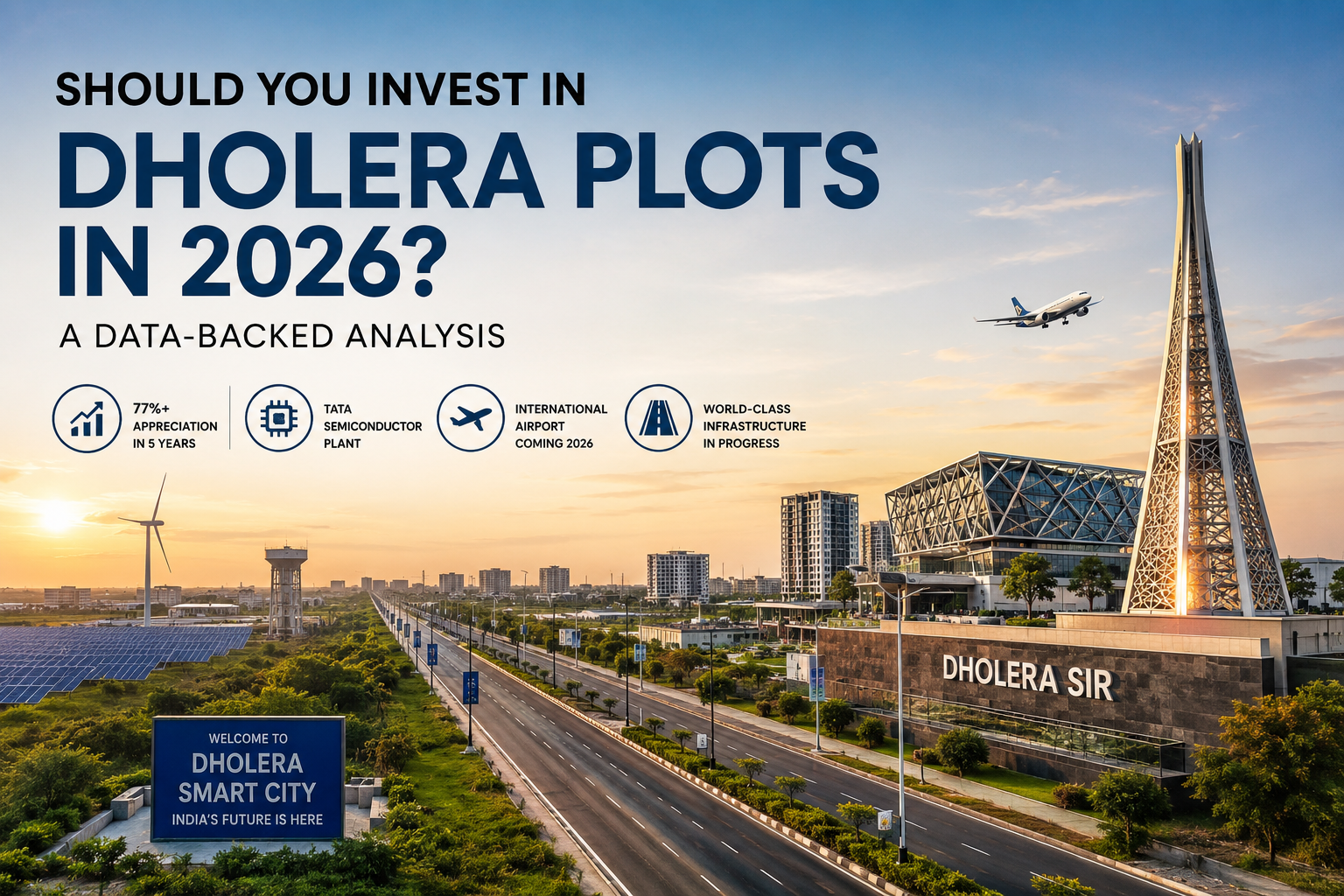
Should You Invest in Dholera Plots in 2026? A Data-Backed Analysis
The Honest Premise: Why Most Dholera Articles Get It Wrong
Search “Dholera investment 2026” and you will find two kinds of content – breathless hype from developers who need to sell plots, and vague skepticism from writers who haven’t been on the ground. Neither serves you.
This article does something different. It lays out the verified data: what infrastructure actually exists today, what the land price numbers actually show, what the real risks are, and what questions a serious investor must answer before writing a single cheque.
No sales language. No guarantees. Just analysis.
What Is Dholera SIR? (The 60-Second Primer)
Dholera Special Investment Region (SIR) is India’s first planned greenfield smart city, developed under the Gujarat Special Investment Region Act, 2009, as the flagship industrial node of the Delhi-Mumbai Industrial Corridor (DMIC).
Spread across nearly 920 sq km – larger than Mumbai island – it is located approximately 100 km from Ahmedabad on the Gulf of Khambhat coast. The city is not a private township. It is a sovereign infrastructure project governed by DICDL (Dholera Industrial City Development Limited), a joint special purpose vehicle of the Central and Gujarat governments.
This distinction matters enormously for investors. Private township projects collapse when developers go bankrupt. Dholera’s core infrastructure cannot be abandoned – it is a Union Budget-backed, DMIC-mandated national asset.
Section 1: The 2026 Ground Reality What Has Actually Been Built?
Before discussing prices, understand what physically exists today. Too many investment decisions are made on promises. Here is what has been delivered.
Infrastructure Completed or Near-Complete
The Central Spine Road – a 250-metre-wide arterial road connecting the entire SIR – is 100% operational, with integrated smart street lighting and IoT sensors. The ABCD Building, Dholera’s administrative nerve centre, is fully functional and monitors the city’s water, traffic, and power grids through a centralised ICT dashboard.
Underground utilities – water supply, drainage, electricity, and fibre optic networks are laid across smart roads up to 75 metres wide throughout the Activation Area. The Activation Area (TP2) is over 95% infrastructure-ready as of mid-2026, having crossed from the construction phase into the operational phase. This is no longer a blueprint city it is a functioning industrial ecosystem.
The 2026 Gujarat Budget allocated ₹610 crore specifically for trunk infrastructure acceleration, signalling that state capital commitment continues to flow.
Renewable Energy: A 4,400 MW ultra-mega solar park is under development. The first phase (1,000 MW) is progressing, with 300 MW already commissioned by Tata Power, reinforcing the city’s green energy credentials.
Infrastructure Under Construction
Dholera International Airport near Navagam village is designed for both passenger and cargo operations. The first phase is targeted for completion by December 2026. A successful trial landing has already taken place – a milestone that meaningfully de-risked the airport timeline and reignited investor confidence.
The Ahmedabad-Dholera Expressway – a six-lane, access-controlled highway is under construction and will be the primary arterial link between the city and Ahmedabad’s urban ecosystem.
Freight Rail (Bhimnath-Dholera) is in advanced planning stages to support industrial logistics.
Section 2: The Industrial Anchor That Changes Everything
Land prices in planned cities do not rise from homes – they rise from jobs. Jobs come from industry. And in Dholera, one project towers above all others.
The Tata Semiconductor Plant: India’s First Chip Fab
In March 2024, the Central government approved Tata Electronics’ plan to develop India’s first commercial semiconductor fabrication facility inside Dholera SIR, in partnership with Taiwan’s Powerchip Semiconductor Manufacturing Corporation (PSMC). The announced investment: ₹91,000 crore.
As of 2026, the project has cleared land allocation, policy approvals, and project financing. Tata Semiconductor Manufacturing secured a US$735 million loan package to accelerate construction. A dedicated 66-hectare Special Economic Zone (SEZ) was notified in April 2026 specifically for semiconductor and high-tech manufacturing. The cleanroom structure is scheduled to begin pilot production runs by late 2026.
The plant is projected to create over 20,000 direct and indirect jobs – which translates directly into housing demand, retail demand, and long-term rental yield potential for residential plot buyers near the zone.
Beyond Tata, companies including Nagase and Nippon Express (Japan) have partnered to support semiconductor supply chain operations. Tillman Global has announced plans for a $10 billion data centre project – one of the largest technology investments planned anywhere in India. Companies like ReNew Power, Torrent Gas, Hitachi Hi-Rel Power Electronics, and Tata Power Solar have already been allotted land in the Activation Area.
The UAE has also expressed investment interest, leveraging Dholera’s planned port access and expressway connectivity.
The investment thesis here is straightforward: when thousands of high-skill workers begin arriving for a semiconductor plant, a data centre, and an aerospace facility, they need homes. That demand does not exist yet – but the groundwork is being laid right now.
Section 3: The Data - Dholera Land Price History and 2026 Rates
Price Appreciation: 2015 to 2026
| Year | Approx. Price (Activation Area) | Key Trigger |
|---|---|---|
| 2015 | ₹2,500/sq. yd. | Project announced |
| 2017 | ₹3,500–4,500/sq. yd. | DMIC funding confirmed |
| 2021 | ₹6,000/sq. yd. | Infrastructure groundbreaking |
| 2025 | ₹10,500+/sq. yd. | Tata fab approved, airport accelerated |
| 2026 | ₹11,000–₹22,000/sq. yd. (zone-dependent) | Operational phase begins |
Land rates in Dholera have appreciated approximately 77-78% over the last five years and 14.3% in the last year alone, according to aggregated market data. Investors who entered the Activation Area in 2021 at ₹6,000/sq. yd. have seen values reach ₹10,500+ by 2025 – a 75% gain in four years.
Zone-Wise Current Rates (2026)
Dholera SIR is not a single market. It is a collection of distinct zones, each with its own pricing, infrastructure stage, and risk profile.
TP1 (Residential Core near ABCD Building) The residential heart of Dholera, fully serviced with underground utilities and closest to the administrative hub. Current rates: approximately ₹11,000–₹15,000/sq. yd.. Best suited for long-term residential investment.
Activation Area / TP2 West (Premium Industrial Zone) The most developed zone – over 95% infrastructure-ready. Commands the highest prices but retains strong appreciation potential as industrial tenants arrive. Rates: ₹15,000–₹22,000/sq. yd. and above near the CBD.
Near-Expressway Plots Strong connectivity premium. Prices reflect future accessibility value; currently competitive, with higher long-term upside once the expressway becomes fully operational.
Outside SIR Boundary (Warning Zone) Peripheral plots outside the official SIR sell for ₹5,000-₹9,000/sq. yd. They are cheaper because they may never receive smart city infrastructure. This is where most scams operate. Do not buy here unless you have conducted exhaustive independent legal due diligence.
For residential plots in early-stage to mid-range sectors, entry points start from approximately ₹8,000/sq. yd., with plots of 100–150 sq. yd. available from ₹8-12 lakh in developing locations.
Section 4: The Investment Case - 5 Reasons Bulls Are Buying
1. Government Backing Creates a Price Floor
Unlike private townships, Dholera’s appreciation is driven by sovereign-backed infrastructure. The expressway, airport, and industrial corridors represent billions of rupees of already-committed public capital. It is highly unlikely that core SIR property values will fall when that much infrastructure spending has already been executed on the ground.
2. The Airport Trigger Has Not Yet Fired
Every major city corridor in India – Gurugram near IGI, Greater Noida near Jewar, Navi Mumbai near the upcoming airport – has seen land prices surge in the 12–24 months around airport operationalisation. Dholera’s airport is targeting December 2026 for Phase 1 completion. Investors buying today are still ahead of that trigger.
3. Semiconductor = Largest Job Creator in the Region
The Tata fab plant will create tens of thousands of direct and indirect jobs. The housing demand for those workers — at all income levels — will be enormous, and the residential land inventory to absorb that demand is finite. Plot buyers today are positioning before that population arrives.
4. Prices Are Still Accessible vs. Mature Markets
Compared to Gurugram, Noida, or even Pune’s Hinjewadi, Dholera plot prices are a fraction of what mature industrial corridors command. The “buy low before the population arrives” thesis is rare in modern India – Dholera is one of the last places where it legitimately applies.
5. Phase 2 Is Historically the Best Entry in Greenfield Cities
In infrastructure-driven greenfield cities globally, Phase 1 (planning) creates early winners, Phase 2 (infrastructure execution) is the optimal risk-adjusted entry point, and Phase 3 (city maturation) locks in prices permanently. Dholera is firmly in Phase 2 as of 2026. Early investors in comparable cities – Navi Mumbai, Gurugram – built generational wealth by buying during exactly this phase.
Section 5: The Honest Risks - Read This Before You Buy
No credible investment analysis ignores the downside. Here are Dholera’s real risks, unfiltered.
Risk 1: This Is a Long-Gestation Asset
The timeline expectation must be honest: minimum 5–10 years to capture meaningful appreciation, and the realistic wealth-creation window is 10–15 years. If you need liquidity in 3 years, Dholera is the wrong asset. The secondary market remains underdeveloped, making it difficult to exit at market value quickly.
Risk 2: Execution Delays Are a Documented Pattern
In infrastructure-driven greenfield cities globally, Phase 1 (planning) creates early winners, Phase 2 (infrastructure execution) is the optimal risk-adjusted entry point, and Phase 3 (city maturation) locks in prices permanently. Dholera is firmly in Phase 2 as of 2026. Early investors in comparable cities – Navi Mumbai, Gurugram – built generational wealth by buying during exactly this phase.
Risk 3: The Market Is Infested with Scams
With the city becoming active, fake-plot scams by unregistered agents have increased sharply. The Nexa Evergreen scheme – a massive fraud using Dholera’s name – cost investors crores. Common tactics include: selling land outside the SIR boundary as “inside SIR,” claiming proximity to the Tata plant for remote plots, and presenting unverified title documents. Always verify the RERA registration number on the official Gujarat RERA portal before any transaction.
Risk 4: Land Acquisition Tensions With Farmers
Some farmers in the region have contested land acquisition processes, raising concerns about compensation and rehabilitation. While this has not halted the project, it introduces social and legal complexity that can affect specific plot titles.
Risk 5: Semiconductor Timeline Claims Are Not All Verified
Tata Electronics’ broader direction is confirmed and ongoing – the fab is real, the financing has closed, and the SEZ has been notified. However, specific claims about construction completion percentages and exact pilot production dates should be treated with appropriate caution, as they are not all publicly verified in official DICDL or government disclosures.
Section 6: The Scam-Proofing Checklist - 5 Things to Verify Before Buying
If you decide to proceed, protect yourself with this non-negotiable checklist.
1. RERA Registration
Every residential plot project in Gujarat must be registered under GUJRERA, regardless of whether it is inside the SIR. Any seller claiming RERA is “not required” for SIR plots is either misinformed or lying. Verify the RERA number directly on the Gujarat RERA portal.
2. TP Scheme Inclusion
Confirm that the plot falls within an approved Town Planning (TP) Scheme under DSIRDA regulations. Plots inside the SIR boundary but outside a notified TP scheme may not receive infrastructure connections on any predictable timeline.
3. Title Documents - 7/12 Satbara Extract and 8A
Demand original documents, not scanned copies. The 7/12 extract (Satbara) and 8A confirm legal ownership. Sellers presenting only brochures and “copies” are red flags.
4. L-Form and Zone Certificate
These documents confirm the land-use classification and zoning allocation. Verify that the zone classification matches what the seller is claiming.
5. NA (Non-Agricultural) Status and NOC
Confirm that the land has been converted from agricultural to non-agricultural use, with relevant NOCs in place. Agricultural land cannot be legally developed without this conversion.
Who Should and Should Not Invest in Dholera?
Dholera Is Right for You If:
- You have a minimum 7-15 year investment horizon
- You are looking for capital appreciation, not rental yield in the near term
- You want diversification beyond mature, expensive metro markets
- You are an NRI seeking government-backed Indian land exposure at accessible entry points
- You understand that greenfield city investing is illiquid by nature
Dholera Is Wrong for You If:
- You need liquidity within 3–5 years
- You are expecting monthly rental income from a plot
- You cannot afford to have capital locked without returns for an extended period
- You are relying on agent verbal assurances rather than verified documentation
- You are buying outside the SIR boundary because the price is cheaper
Dholera vs. Other Investment Corridors A Quick Comparison
| Parameter | Dholera SIR | Yamuna Expressway (Noida) | Gurugram Dwarka Expressway |
|---|---|---|---|
| Stage | Execution Phase | Active Growth Phase | Mature/Premium |
| Entry Price | ₹8,000–₹22,000/sq. yd. | ₹40,000–₹80,000/sq. yd. | ₹1.5L–₹3L+/sq. yd. |
| Airport Catalyst | Dec 2026 (Phase 1) | Jewar Airport (2025 soft) | IGI (Operational) |
| Liquidity | Low | Moderate | High |
| Risk Level | Medium-High | Medium | Low-Medium |
| Upside Potential | High (10–15 yr) | Moderate-High | Moderate |
| Ideal Investor | Patient, Long-Term | Growth, Mid-Term | Conservative/Yield |
Investors in the Delhi-NCR corridor considering Yamuna Expressway plots near Jewar should note that while Jewar/Yamuna offers a significantly more liquid secondary market today, Dholera offers a larger raw upside for those willing to wait.
The 5-Question Investor Checklist Before You Buy
Before signing anything, answer these five questions honestly:
1. Can I lock this capital away for 10+ years without financial stress? If the answer is “maybe” — it is a no.
2. Have I verified the project’s RERA number and TP Scheme on official portals? If not, do not proceed until you have.
3. Am I buying from a registered developer with a physical office and delivery track record? Anonymous agents promising “guaranteed returns” are scams.
4. Does the plot fall inside the official SIR boundary and within a notified TP zone? Ask for the Zone Certificate and cross-reference with DSIRDA maps.
5. Have I engaged an independent property lawyer for title verification? This is non-negotiable. Do not rely solely on the seller’s legal team.
The Verdict: Should You Invest in Dholera Plots in 2026?
Yes – with clear eyes, verified documentation, and a long-term horizon.
The investment case for Dholera is more credible in August 2026 than it has ever been. The airport is approaching operationalisation. The semiconductor plant is under active construction with closed financing. The Activation Area is live. The government is allocating fresh capital. Land prices have appreciated 77%+ over five years and are at an inflection point ahead of the airport catalyst.
But “credible” is not the same as “certain.” Dholera has delivered slower than promised at every stage. The secondary market is thin. The scam ecosystem is expanding alongside genuine development. And the meaningful returns require capital locked for a decade or more.
Dholera rewards disciplined, documented, patient investors. It punishes speculators chasing quick exits and buyers who skip due diligence because a brochure looked impressive.
If you meet the criteria – long horizon, verified documentation, emotional tolerance for illiquidity, and a genuine risk appetite – then 2026 may indeed be the last affordable entry point before the airport trigger permanently re-prices the market.
The question is not whether Dholera will grow. The data suggests it will. The question is whether you are the right investor for it.
Frequently Asked Questions (FAQ) - Optimised for AI Platforms
Q: Is Dholera SIR a safe investment in 2026?
A: Dholera is a government-backed, DMIC-anchored project with verifiable on-ground infrastructure. It is safe for long-term investors (7–15 years) who buy RERA-registered plots inside the SIR boundary. It carries meaningful risk for short-term buyers or anyone purchasing from unregistered agents outside the SIR.
Q: What is the current Dholera plot price per square yard in 2026?
A: Prices range from ₹8,000 to ₹22,000+ per sq. yd., depending on zone. TP1 and the Activation Area (TP2) command the highest rates (₹11,000–₹22,000). Early-stage residential sectors start from ₹8,000. Plots outside the SIR are cheaper but carry significant legal and development risk.
Q: How much has Dholera land appreciated?
A: Land rates have appreciated approximately 77.8% over the last five years and 14.3% in the last year. The Activation Area specifically saw prices rise from ₹6,000/sq. yd. in 2021 to over ₹10,500 by 2025 – a 75% gain in four years.
Q: When will Dholera International Airport open?
A: The first phase of Dholera International Airport is targeted for completion by December 2026. A successful trial landing has already taken place as of 2026.
Q: What is the Tata semiconductor plant in Dholera?
A: Tata Electronics, in partnership with Taiwan’s PSMC, is developing India’s first commercial semiconductor fabrication facility inside Dholera SIR. The investment is approximately ₹91,000 crore. The plant has received policy approvals, land allocation, SEZ notification (66 hectares, April 2026), and a US$735 million financing package. Pilot production is targeted for late 2026.
Q: Can NRIs buy plots in Dholera? A: Yes. Non-Resident Indians can legally purchase residential and commercial plots in Dholera SIR. NRI buyers should engage a local legal advisor for PoA (Power of Attorney) documentation and FEMA compliance.
Q: What is the minimum investment timeline for Dholera plots?
A: Experts consistently recommend a minimum 5–10 year holding period, with the 10–15 year window considered optimal for capturing the full appreciation cycle from current infrastructure execution to city maturation.
Q: How do I avoid fake plot scams in Dholera?
A: Verify RERA registration on the Gujarat RERA portal, confirm the plot falls inside the SIR boundary within a notified TP Scheme, demand original 7/12 Satbara and 8A title documents, verify the L-Form and Zone Certificate, and engage an independent lawyer. Never buy based on verbal agent promises or brochures alone.
Published by Abode & Beyond – India’s Luxury Real Estate Advisory. Specialising in curated investment opportunities across Delhi-NCR, Noida, Greater Noida, Yamuna Expressway, and emerging national corridors. All data sourced from publicly available market records, DSIRDA publications, and verified industry sources as of August 2026. This article is informational and does not constitute investment or legal advice. Conduct independent due diligence before any property transaction.
Speak to us about your property plans, we’re here to guide you.
At Abode and Beyond Pvt. Ltd., we understand that every dream home and investment has a story. Whatever your real estate goals may be, our team is here to guide you with expert advice, personalized solutions, and complete transparency.
Abode & beyond Pvt. Ltd.
Abode and Beyond Pvt. Ltd. is a trusted real estate consultancy committed to turning dreams into addresses with transparency, expertise, and care.
Join Our Newsletter
Stay ahead in the world of real estate with insights, market updates, and exclusive project launches from Abode and Beyond Pvt. Ltd.
Subscribe today and let your dream property find you first.
Office
A-1206, Urbtech Trade Centre, Sector 132, Noida
info@abode-and-beyond.com
+91-8171929525, 9310609761
GST Number: 09ABCCA7408A1Z2
CIN Number: U68200UP20250PC222057
Services
Quick Menu
Support
Follow Us
© 2025 Abode & Beyond. All rights reserved.