
Real Estate vs Gold vs Equity: Where Should You Invest in 2026?
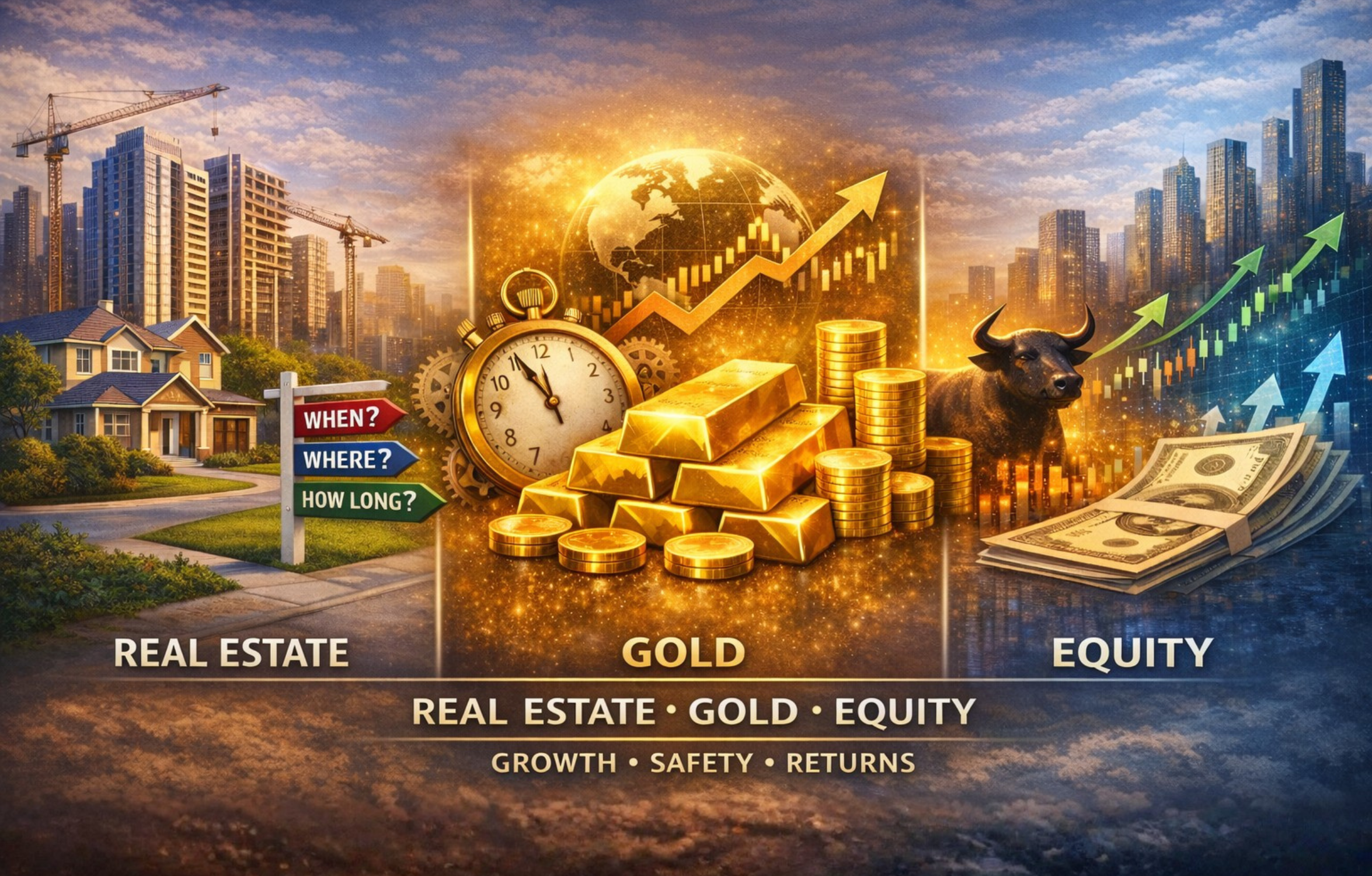
A Smart Investor’s Guide to Choosing the Right Asset
Investors will have more chances than ever in 2026. Selecting the appropriate investment asset has become more crucial than ever due to changes in the economy, growing inflation, fast urbanization, and changing financial markets.
Real estate, gold, and stocks continue to be the three most popular assets for accumulating wealth. They all have distinct benefits, but they also have varying degrees of risk, possible return, and liquidity.
Today’s investors have a straightforward question:
In 2026, where should you put your money to create long-term wealth?
We analyze the advantages, disadvantages, and prospects of gold, stocks, and real estate in this guide to help you make more informed investing choices.
Understanding the Three Major Asset Classesz
Before comparing them, it’s important to understand how each asset works.
Real Estate
Real estate involves investing in land, residential properties, commercial spaces, or rental assets. It generates wealth through capital appreciation and rental income.
Gold
Gold is traditionally considered a safe-haven asset. Investors buy gold as a hedge against inflation, economic instability, and currency depreciation.
Equity (Stocks)
Equity investments involve buying shares in companies. Returns come from stock price appreciation and dividends.
Each asset plays a different role in a diversified portfolio.
Real Estate Investment in 2026
Real estate continues to be one of the most powerful wealth-building assets, especially in growing economies like India.
Why Real Estate Remains Attractive
1. A tangible asset with a long-term worth
Real estate is a tangible asset as opposed to stocks or digital assets. Property and land cannot vanish or disappear completely overnight.
2. Potential for Dual Income
Wealth is produced via real estate through:
- Appreciation of real estate
- Income from rentals
This generates long-term capital growth and cash flow.
3. Growth Driven by Infrastructure
Large-scale infrastructure developments such as airports, industrial corridors, metro extensions, and expressways often cause property values to rise quickly.
For instance, areas near major infrastructure hubs or future economic corridors often have high long-term demand.
4. Advantage of Leverage
With comparatively little capital, real estate enables investors to control high-value assets through home loans.
This leverage can greatly increase overall returns.
5. Protection Against Inflation
Rents and property values typically increase in tandem with inflation, safeguarding buying power over time.
Gold Investment in 2026
Gold has been a trusted store of value for centuries.
During periods of economic uncertainty, geopolitical tensions, and currency fluctuations, investors often move toward gold.
Benefits of Gold
Asset of Safe Haven
When markets are erratic, gold does well.
Protect Yourself Against Inflation
When currencies decline, gold helps maintain value.
Elevated Liquidity
In international markets, gold can be sold swiftly.
Gold's limitations
Gold has certain disadvantages, even though it provides stability:
- No revenue production (no dividends or rent)
- Prolonged periods of price stagnation
- Reduced long-term gains in contrast to stocks
Generally speaking, gold works better as a portfolio stabilizer than as a main source of wealth.
Equity Investment in 2026
Equities have historically delivered the highest long-term returns among traditional assets.
Stock markets benefit from economic growth, technological innovation, and corporate expansion.
Benefits of Investing in Equity
High Potential for Return
Over time, stocks have the potential to produce substantial wealth.
The degree of liquidity
In stock markets, shares can be purchased and traded quickly.
The process of diversification
Investors can make investments in a variety of industries and businesses.
Equity Risks
Volatility is another feature of stocks.
Prices may vary greatly because of:
- Economic downturns
- Changes in interest rates
- shocks to the world market
- problems with corporate performance
Market volatility is a common problem for short-term investors.
Real Estate vs Gold vs Equity: A Comparison
Factor | Real Estate | Gold | Equity |
Tangibility | Physical Asset | Physical/Digital | Digital |
Income Generation | Rental Income | None | Dividends |
Volatility | Low to Moderate | Low | High |
Liquidity | Medium | High | Very High |
Leverage | Available | Not available | Limited |
Long-Term Wealth Creation | Strong | Moderate | Strong |
Each asset serves a different investment objective.
Which Investment Performs Best in the Long Run?
Historically:
- Equities deliver the highest returns
- Real estate builds stable long-term wealth
- Gold protects value during uncertainty
However, successful investors rarely rely on a single asset.
Instead, they build balanced portfolios.
The Smart Investment Strategy for 2026
Rather than choosing only one asset, experts recommend strategic diversification.
A balanced portfolio might look like:
- Real Estate: 40–50% (long-term wealth + income)
- Equities: 30–40% (growth and compounding)
- Gold: 10–20% (stability and hedge)
This approach allows investors to benefit from growth, stability, and diversification simultaneously.
Why Real Estate Is Becoming a Core Asset Again
Investment prospects in real estate are being strengthened by a number of macrotrends.
Urban Growth
Cities keep growing in the direction of new infrastructural zones and corridors.
Development of Infrastructure
Property markets are changing as a result of highways, airports, and metro networks.
Luxurious and Branded Homes
New demand segments are being created by the entry of luxury developers and international brands into Indian real estate markets.
Growing Demand for Rentals
Major cities are seeing an increase in rental demand due to urban migration and the growth of the professional workforce.
Real estate is positioned as a key long-term asset for wealth building by these tendencies.
Key Factors to Consider Before Investing
Investors should consider the following factors when selecting an asset class: Investment horizon
- Tolerance for risk
- requirements for liquidity
- prerequisites for income
- objectives for diversification
A well-thought-out investing strategy should be in line with both market opportunities and financial objectives.
The Role of Professional Guidance
When investing in real estate, one must carefully consider the following factors: location, growth potential
- credibility of developers
- legal clearances
- influence on infrastructure
- long-term demand
Before markets peak, seasoned real estate experts assist investors in identifying high-potential possibilities.
Final Thoughts
There is no clear winner in the real estate, gold, or equity discussion.
Every asset has advantages of its own.
- Gold keeps riches safe.
- Equities increase wealth.
- Real estate creates enduring wealth.
The most prosperous investors carefully mix these assets.
However, real estate remains one of the most potent investment vehicles when it comes to generating tangible, long-term generational wealth.
Speak to us about your property plans, we’re here to guide you.
At Abode and Beyond Pvt. Ltd., we understand that every dream home and investment has a story. Whatever your real estate goals may be, our team is here to guide you with expert advice, personalized solutions, and complete transparency.
Abode & beyond Pvt. Ltd.
Abode and Beyond Pvt. Ltd. is a trusted real estate consultancy committed to turning dreams into addresses with transparency, expertise, and care.
Join Our Newsletter
Stay ahead in the world of real estate with insights, market updates, and exclusive project launches from Abode and Beyond Pvt. Ltd. Subscribe today and let your dream property find you first.
Office
A-1206, Urbtech Trade Centre, Sector 132, Noida
info@abode-and-beyond.com
+91-8171929525, 9310609761
GST Number: 09ABCCA7408A1Z2
CIN Number: U68200UP20250PC222057
Services
Quick Menu
Support
Follow Us
© 2025 Abode & Beyond. All rights reserved.